
Sustainable Development Goals
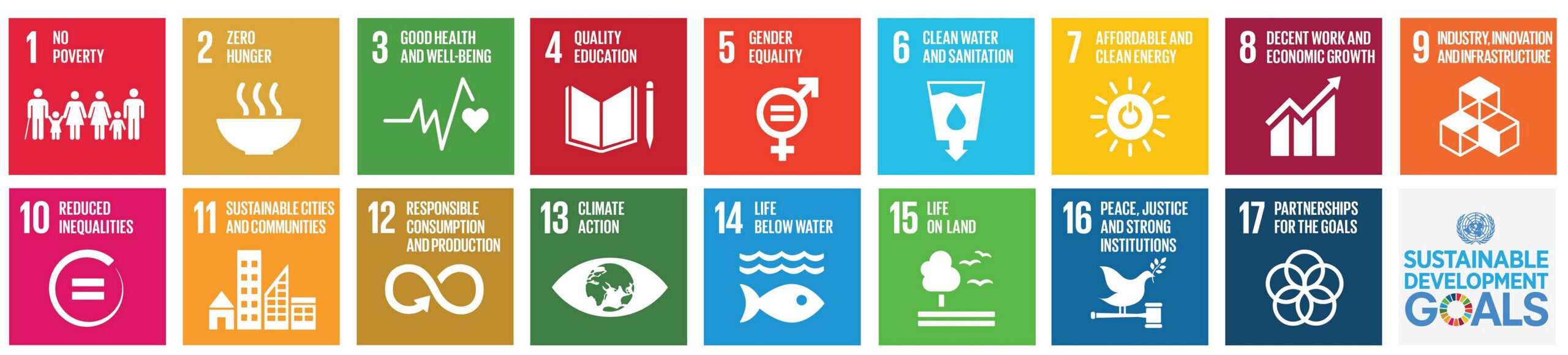
The Sustainable Development Goals (SDGs), also known as the Global Goals, were adopted by the United Nations in 2015 as a universal call to action to end poverty, protect the planet, and ensure that by 2030 all people enjoy peace and prosperity. The 17 SDGs are integrated—they recognize that action in one area will affect outcomes in others, and that development must balance social, economic and environmental sustainability. Countries have committed to prioritize progress for those who’re furthest behind. The SDGs are designed to end poverty, hunger, AIDS, and discrimination against women and girls. The creativity, knowhow, technology and financial resources from all of society is necessary to achieve the SDGs in every context.
Eradicating poverty in all its forms remains one of the greatest challenges facing humanity. While the number of people living in extreme poverty dropped by more than half between 1990 and 2015, too many are still struggling for the most basic human needs.

Many developing countries that used to suffer from famine and hunger can now meet their nutritional needs. Central and East Asia, Latin America and the Caribbean have all made huge progress in eradicating extreme hunger.

Good health is essential to sustainable development and the 2030 Agenda reflects the complexity and interconnectedness of the two. Universal health coverage will be integral to achieving SDG 3, ending poverty and reducing inequalities. For more click here

Since 2000, there has been enormous progress in achieving the target of universal primary education. The total enrolment rate in developing regions reached 91 percent in 2015, and the worldwide number of children out of school has dropped by almost half. There has also been a dramatic increase in literacy rates. These are all remarkable successes. For more click here

Ending all discrimination against women and girls is not only a basic human right, it’s crucial for sustainable future; it’s proven that empowering women and girls helps economic growth and development. UNDP has made gender equality central to its work and we’ve seen remarkable progress in the past 20 years.
Water scarcity affects more than 40 percent of people, an alarming figure that is projected to rise as temperatures do. Although 2.1 billion people have improved water sanitation since 1990, dwindling drinking water supplies are affecting every continent. More and more countries are experiencing water stress, and increasing drought and desertification is already worsening these trends.
Between 2000 and 2018, the number of people with electricity increased from 78 to 90 percent, and the numbers without electricity dipped to 789 million. Yet as the population continues to grow, so will the demand for cheap energy, and an economy reliant on fossil fuels is creating drastic changes to our climate. For more click here

Over the past 25 years the number of workers living in extreme poverty has declined dramatically, despite the lasting impact of the 2008 economic crisis and global recession. In developing countries, the middle class now makes up more than 34 percent of total employment – a number that has almost tripled between 1991 and 2015.
Investment in infrastructure and innovation are crucial drivers of economic growth and development. With over half the world population now living in cities, mass transport and renewable energy are becoming ever more important, as are the growth of new industries and information and communication technologies.
Income inequality is on the rise—the richest 10 percent have up to 40 percent of global income whereas the poorest 10 percent earn only between 2 to 7 percent. If we take into account population growth inequality in developing countries, inequality has increased by 11 percent.

More than half of us live in cities. By 2050, two-thirds of all humanity—6.5 billion people—will be urban. Sustainable development cannot be achieved without significantly transforming the way we build and manage our urban spaces.

Achieving economic growth and sustainable development requires that we urgently reduce our ecological footprint by changing the way we produce and consume goods and resources. Agriculture is the biggest user of water worldwide, and irrigation now claims close to 70 percent of all freshwater for human use.
There is no country that is not experiencing the drastic effects of climate change. Greenhouse gas emissions are more than 50 percent higher than in 1990. Global warming is causing long-lasting changes to our climate system, which threatens irreversible consequences if we do not act.
The world’s oceans – their temperature, chemistry, currents and life – drive global systems that make the Earth habitable for humankind. How we manage this vital resource is essential for humanity as a whole, and to counterbalance the effects of climate change.

Human life depends on the earth as much as the ocean for our sustenance and livelihoods. Plant life provides 80 percent of the human diet, and we rely on agriculture as an important economic resources. Forests cover 30 percent of the Earth’s surface, provide vital habitats for millions of species, and important sources for clean air and water, as well as being crucial for combating climate change.
We cannot hope for sustainable development without peace, stability, human rights and effective governance, based on the rule of law. Yet our world is increasingly divided. Some regions enjoy peace, security and prosperity, while others fall into seemingly endless cycles of conflict and violence. This is not inevitable and must be addressed.
The SDGs can only be realized with strong global partnerships and cooperation. Official Development Assistance remained steady but below target, at US$147 billion in 2017. While humanitarian crises brought on by conflict or natural disasters continue to demand more financial resources and aid. Many countries also require Official Development Assistance to encourage growth and trade.